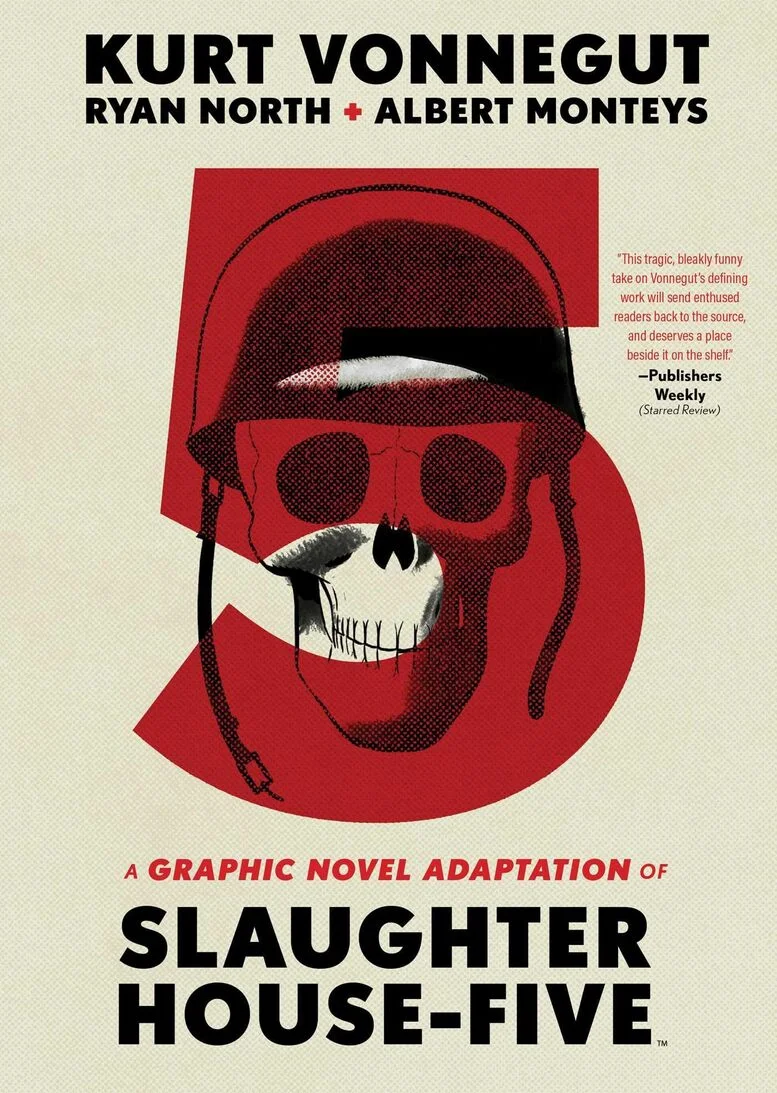
Kurt Vonnegut’s Slaughterhouse-Five presents a fragmented view of reality, memory, and identity through the protagonist Billy Pilgrim, who becomes “unstuck in time.” This non-linear existence, enabled by the book’s science-fictional concept of time travel, challenges conventional understandings of the self.
Time travel is not merely a plot device; it fundamentally reframes Billy’s perception of life, war, death, and meaning, creating a multidimensional identity rooted not in continuity, but in recurrence.
Fixed timeline and fractured self
Unlike stories that treat time travel as an opportunity to change the past or future, Slaughterhouse-Five presents time as fixed. Billy does not choose when or where he travels; he is flung from one moment to another with no control, visiting episodes of his life in no particular order. This structure denies the traditional narrative of personal growth and change. Instead of becoming someone new through time, Billy becomes a being who exists perpetually across all his experiences, without evolution or linear transformation.
This concept dismantles the idea of identity as something that accumulates over time. Billy is not defined by progression, but by simultaneity. He is, at all times, the child taken by the Germans, the man witnessing the Dresden bombing, the optometrist in Ilium, and the captive of the Tralfamadorians.
Tralfamadorian philosophy and determinism
The alien race known as the Tralfamadorians introduces Billy to a new way of seeing time. They perceive all moments at once, much like a mountain range—each moment permanent, coexisting with every other. Their perspective rejects the idea of free will, insisting that everything that happens is inevitable and unchangeable.
This worldview reshapes Billy’s sense of responsibility and personal agency. His detachment from events in his life—especially traumatic ones—can be seen as a coping mechanism adopted from the Tralfamadorians. He echoes their fatalistic phrase “so it goes” every time death occurs. By embracing this deterministic view of time, Billy distances himself from pain, guilt, and moral judgment.
The Tralfamadorian view reframes identity as an eternal set of moments, rather than a self shaped by choice or circumstance. Billy no longer attempts to understand why things happen; he only acknowledges that they do, repeatedly and permanently.
Memory and narrative disintegration
Billy’s time travel reflects the psychological condition of post-traumatic stress. The non-linear narration, mirroring his temporal dislocation, presents identity not as an integrated whole but as a patchwork of disconnected impressions. His memories of Dresden, where he witnessed one of the most devastating bombings in World War II, do not fade into the past—they are relived as vividly as the present.
This temporal disorder dismantles the stability of memory, which traditionally allows people to create a coherent story about who they are. In Billy’s case, memory is involuntary, intrusive, and unbound by chronology. It strips him of control over his own narrative, making his identity feel arbitrary and fragmented.
Vonnegut’s use of time travel captures how trauma can sever the past from any sense of order. Rather than aging into wisdom, Billy is trapped in a loop of disjointed experiences that define him but offer no resolution.
Contradictions in public and private identity
Billy’s public life as an optometrist and family man contrasts sharply with his private experiences of alien abduction, temporal dislocation, and recurring war trauma. His identity exists in contradiction: socially constructed stability versus internal chaos. As he drifts through time, these aspects never reconcile. He is simultaneously respected in his community and dismissed as delusional when he discusses Tralfamadore.
The dissonance between how he is perceived and how he perceives himself underscores the instability of identity in a temporally nonlinear world. The reader is forced to ask: is Billy insane, or is he genuinely unstuck in time? Vonnegut avoids confirming either interpretation, which reflects how time travel functions metaphorically to show the unbridgeable gap between internal reality and external identity.
Symbolic moments as fixed identity markers
Despite the fluidity of time, certain moments recur with greater emphasis, functioning almost like anchor points in Billy’s identity. These include:
- The bombing of Dresden
- The death of Billy’s wife
- The crash of the plane he survives
- His experience with the Tralfamadorians
These events form a constellation of experience that define him more than chronology ever could. Their recurrence reinforces the idea that identity is composed of intense, irreversible experiences, rather than a gradual accumulation of change. They become static coordinates in the structure of Billy’s existence, always visited and never left behind.
Personal agency and emotional detachment
The linearity of time typically supports the concept of agency—the idea that individuals can change their future by learning from their past. In Slaughterhouse-Five, time travel invalidates this principle. Since every moment is fixed, Billy loses the belief that his actions matter.
This contributes to his emotional detachment. He rarely expresses fear, anger, or hope. He does not attempt to prevent events or alter outcomes. Even death is treated with indifference. This numbness reflects the psychological damage of war, reframed through the lens of time travel. Billy’s identity is shaped less by who he tries to be and more by what he can no longer feel.
Table of temporal locations and psychological impact
| Temporal Moment | Identity Impact |
|---|---|
| World War II, Dresden bombing | Defines his trauma and passive stance toward violence |
| Plane crash and hospital recovery | Triggers stronger belief in Tralfamadorian worldview |
| Optometry career and suburban life | Establishes contrast between ordinary life and internal chaos |
| Time spent on Tralfamadore | Solidifies detachment and non-linear understanding of self |
The author’s own dislocation
Vonnegut inserts himself into the text in subtle ways, especially in the first and final chapters. His voice blends with the narrative, suggesting that Billy’s temporal confusion reflects Vonnegut’s own difficulty in processing his wartime experiences. The time travel mechanism becomes a form of autobiography, filtered through fiction. Billy’s fractured identity mirrors Vonnegut’s effort to grasp a coherent meaning from the trauma of war.
By dissolving the traditional boundaries of time, Vonnegut constructs a character who is always every version of himself, never just one. The result is a portrait of identity shaped less by choice than by circumstance, memory, and a refusal—or inability—to forget.
Repetition as a form of permanence
Time travel in Slaughterhouse-Five ultimately serves to repeat, not reinvent. The idea that one cannot escape the past, and that every moment is eternal, creates a new kind of identity: one where transformation is impossible and selfhood is an infinite loop. Billy exists not to grow, but to persist—permanently framed by a set of irreversible experiences that resurface regardless of where in time he lands.
This interpretation disrupts traditional storytelling and psychological models alike. Identity becomes not a story with a beginning, middle, and end, but a collage of moments in eternal recurrence. In this vision of time, selfhood is not an arc—it is a pattern.