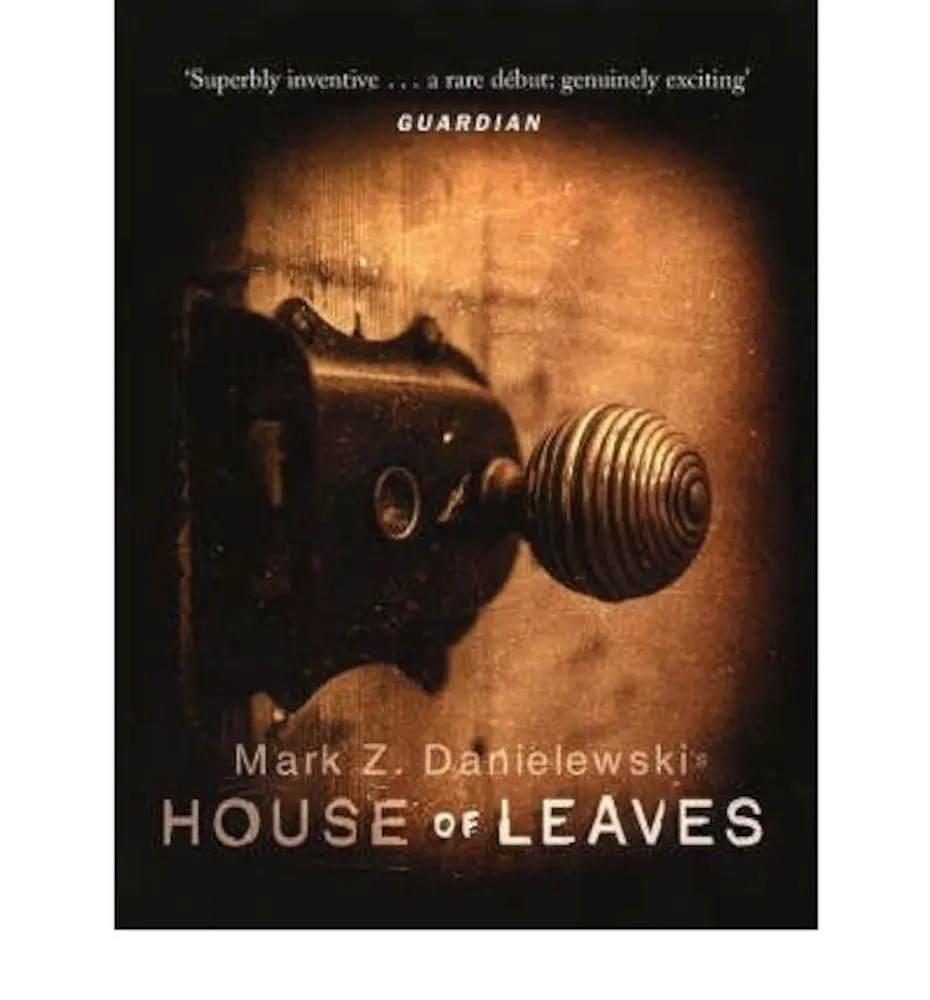
Mark Z. Danielewski’s House of Leaves introduces a house that operates outside the accepted rules of physical space. What begins as a small architectural anomaly—a closet measuring slightly larger on the inside—escalates into a reality-warping revelation. The house contains rooms and corridors that do not fit within the building’s external dimensions. For example, a hallway behind a closet wall stretches far beyond what should be possible, revealing an internal space that constantly shifts in size and layout.
The discrepancies are not limited to subtle illusions. Attempts to map the house using rulers, compasses, and video recordings yield contradictory results. Sometimes a staircase descends for miles, other times it ends abruptly. These shifts occur without any noise or visible renovation, suggesting that the space itself is unstable, reconfiguring at will.
Violations of physical law
The house disobeys the principles of Euclidean geometry. Angles that should measure 90 degrees seem subtly wrong, walls do not align, and gravity behaves inconsistently in certain rooms. When characters descend into the deeper sections of the house, they find entire chasms and massive hallways where nothing should exist.
Notable violations include:
- Length distortion: A hallway may measure 10 feet one moment and several hundred the next.
- Directional anomalies: Characters turn left or right but do not end up where they expect, as if orientation itself has become meaningless.
- Unreliable gravity: Sound and physical movement behave strangely, particularly in the descending spiral staircase, where echoes are delayed and objects fall at irregular speeds.
These traits render the house incompatible with any naturalistic or scientific explanation. It appears to exist as an independent structure with rules of its own.
A psychological mirror
Beyond the physical disarray, the house operates as a psychological enigma. Those who spend time within it begin to unravel mentally. Will Navidson, initially a composed photojournalist, becomes obsessed with documenting the phenomenon. His descent mirrors the house’s own descent into deeper and darker spaces. Karen, his partner, experiences rising claustrophobia, agoraphobia, and a growing sense of alienation. The space reflects her internal fear of commitment and abandonment.
For each person, the house seems to take on a different form, tailored to expose personal weaknesses. Rather than being a fixed structure, the house acts as a psychological amplifier. Fear, doubt, guilt, and obsession are heightened to unbearable levels. It becomes increasingly unclear whether the house warps the minds of its inhabitants or merely exposes the instability that was already there.
The collapse of narrative structure
Danielewski’s novel itself is structured like the house it describes. The primary narrative, the Navidson Record, is documented by Zampanò, an old blind man whose analysis reads like a dense academic text. That manuscript is discovered and annotated by Johnny Truant, a troubled tattoo parlor assistant, who descends into his own madness as he reads and edits the work.
This layering of narratives becomes physically manifested in the layout of the book. Text shifts direction, fonts change, footnotes spiral across pages, and certain sections appear fragmented or erased. These visual elements mimic the disorientation of the house. Just as the architecture defies conventional mapping, the story resists linear progression.
Isolation and disconnection
One of the house’s most insidious effects is the way it isolates individuals. Despite being in the same structure, characters become emotionally and physically separated. The deeper they go, the less they are able to communicate or return to the surface. Radio signals fail, ropes snap, and time behaves unpredictably.
This separation is mirrored in their personal relationships. Will and Karen grow distant. Johnny Truant, reading the manuscript in a completely different timeline, becomes increasingly paranoid and delusional. The isolation is not just spatial, but existential.
Several characters experience:
- Disrupted sleep and intense nightmares
- Paranoia and fear of being watched
- Inability to distinguish reality from hallucination
- Breakdowns in communication, both verbal and emotional
Rather than being haunted in a traditional sense, the inhabitants seem to be haunted by themselves and their own internal fractures, which the house magnifies and distorts.
Absence of a fixed center
The house lacks a center. Most buildings are constructed around some core—physically or functionally. But the house at Ash Tree Lane offers no such orientation. There is no heart to the maze, no final room that answers the mystery. Expeditions into its depths turn up endless tunnels, dead ends, or structures that resemble catacombs. This lack of resolution disorients the characters and strips them of any purpose or goal. Even when they try to confront it with tools, logic, and courage, they are met only with silence and darkness.
Unlike traditional haunted houses, which typically serve as metaphors for secrets or sins that must be unearthed and exorcised, this structure does not care to be understood. It neither explains nor punishes. It simply exists, growing more labyrinthine with each visit.
Shifting perception of time
Another bizarre characteristic of the house is its manipulation of time. What feels like minutes in the labyrinth might be hours or days on the outside. The characters often emerge exhausted, dehydrated, and mentally altered, though their watches suggest far less time has passed. This temporal dislocation adds to the psychological deterioration they experience.
At times, the story hints that the house is not simply a space but a mechanism that exists outside of traditional time altogether. When Navidson’s brother Tom attempts to map a portion of the structure, his lines vanish behind him. Corridors seal off silently. It’s not just that the space is hostile—it is actively elusive.
Symbol of existential dread
The house has often been interpreted as a manifestation of existential fear: the fear of meaninglessness, of isolation, and of facing something incomprehensible. It does not kill its visitors. It does not scream or bleed or drag people to hell. It simply offers them a space that cannot be measured or understood—a reflection of chaos and the human inability to make sense of the universe.
This dread seeps into every corner of the novel. Even readers become participants in the puzzle, flipping the book upside down or squinting through redacted footnotes in an attempt to follow the story. The physical act of reading becomes as disorienting as walking through the house.
The genius of House of Leaves lies not just in its depiction of a supernatural building, but in how that building represents the limits of human perception, logic, and sanity. The house does not operate outside the laws of reality as much as it challenges the assumption that such laws are stable. Its horror is not in its aggression, but in its indifference—an infinite, shifting void that reveals nothing except what each person carries into it.