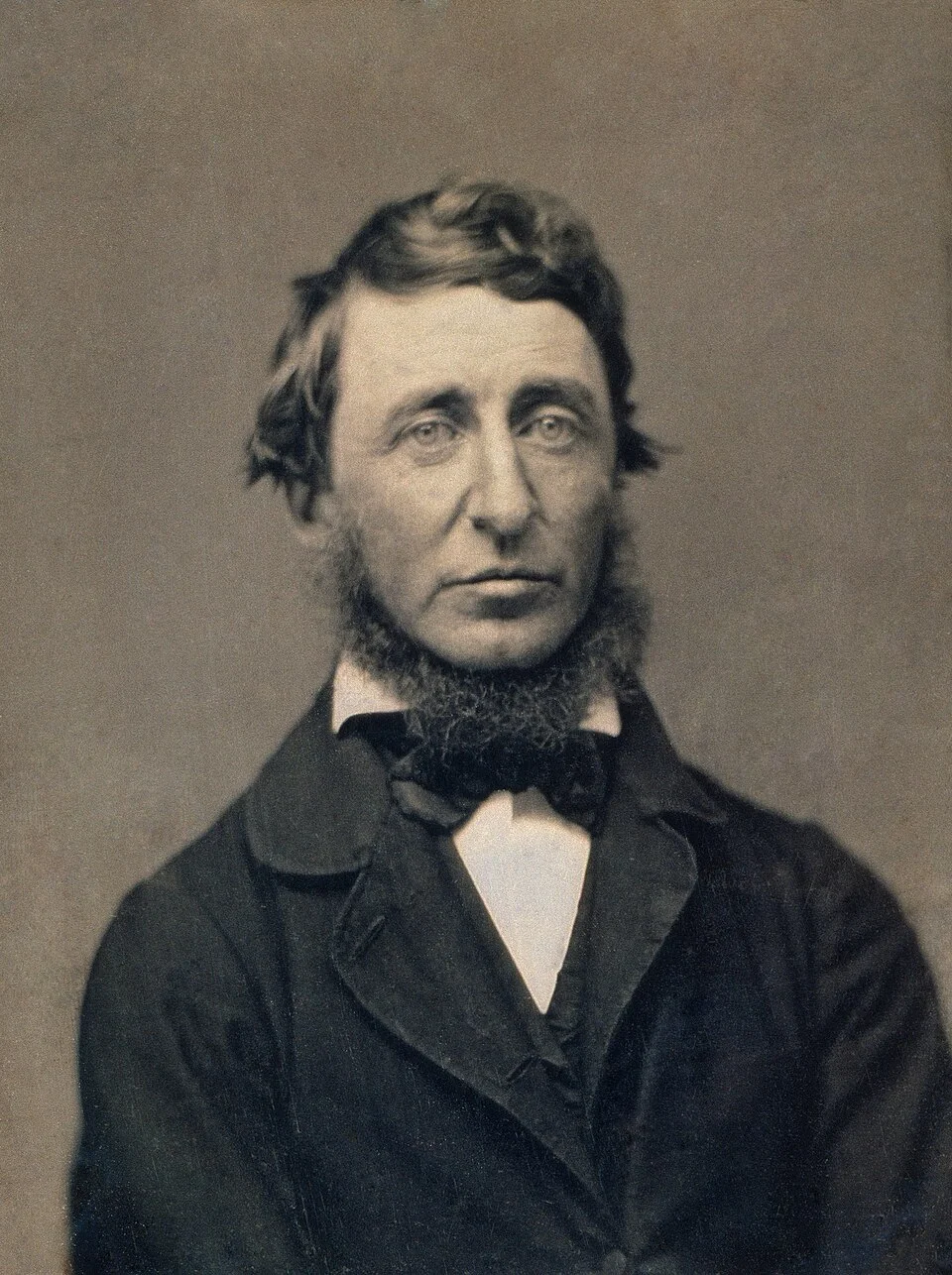
Henry David Thoreau’s experiment at Walden Pond has become one of the most enduring symbols of American literature and philosophy. In July 1845, Thoreau left his hometown of Concord, Massachusetts, to build a small cabin by the shore of Walden Pond, where he would live for a little over two years.
His retreat was not an act of escapism but a deliberate choice, one shaped by personal conviction, intellectual influences, and broader cultural currents of his time. Through this experience, he wrote Walden, a text that blended autobiography, philosophy, and natural observation. The decision to retreat to Walden Pond reveals Thoreau’s quest for simplicity, independence, and truth in a society increasingly driven by materialism and industrialization.
The influence of Transcendentalism
Thoreau’s retreat cannot be understood without reference to the intellectual movement of Transcendentalism, of which he was an active participant. Guided by figures such as Ralph Waldo Emerson, Transcendentalists believed that individuals could achieve deeper spiritual understanding through personal experience with nature rather than through organized religion or social conformity. Thoreau sought to embody these ideals by living deliberately in a natural setting, where he could cultivate self-reliance and explore the relationship between humanity and the environment. Walden Pond offered a physical space for him to put theory into practice, turning abstract philosophy into lived reality.
Escaping industrialization and materialism
The mid-19th century in America was marked by rapid industrial growth, technological innovation, and expanding consumer culture. Thoreau, however, was deeply skeptical of these developments. He viewed the pursuit of wealth, status, and possessions as distractions from meaningful living. By moving to Walden Pond, he symbolically rejected the material values of his society. His cabin, built with his own hands and furnished with the barest essentials, served as a statement against excess. Through this deliberate simplicity, Thoreau aimed to demonstrate that one could live well without being enslaved to economic ambition, thereby critiquing the direction in which American society was heading.
A search for solitude
Thoreau’s retreat was also motivated by a desire for solitude. While not a recluse—he frequently walked into Concord to visit family and friends—he valued the quiet and separation Walden Pond provided. Solitude offered him space for reflection, observation, and writing, free from the constant demands of social interaction. In the stillness of the woods, he could observe the rhythms of nature, reflect on human existence, and focus on his intellectual pursuits. For Thoreau, solitude was not loneliness but an essential condition for personal growth and creativity.
Living deliberately
One of the most famous passages in Walden declares Thoreau’s aim: “to live deliberately, to front only the essential facts of life.” This phrase captures his central motivation for moving to the pond. He sought to strip away the inessential and confront life in its rawest form, to understand what was truly necessary for human fulfillment. By living in a small cabin, growing much of his own food, and immersing himself in the natural world, he hoped to clarify what it meant to live a meaningful life. His retreat was not only about rejecting society’s distractions but also about cultivating a more authentic relationship with existence itself.
The role of nature as teacher
Nature was not merely a backdrop for Thoreau’s experiment; it was the central subject of his study. Walden Pond became a living laboratory where he could observe the cycles of seasons, the behavior of animals, and the beauty of landscapes. These observations filled the pages of Walden, where descriptions of ice breaking in spring or the sound of loons across the water become metaphors for renewal and freedom. For Thoreau, nature offered moral and spiritual lessons that no institution could provide. His retreat was thus an educational endeavor, where the pond and its surroundings served as his teachers.
Independence and self-reliance
Thoreau’s time at Walden was also a test of independence. Inspired by the ideals of self-reliance popularized by Emerson, he wanted to prove that an individual could live with minimal dependence on society. By constructing his cabin, growing beans, and living frugally, he demonstrated that one could meet basic needs without surrendering freedom to economic pressures. This independence was not absolute—he still relied on occasional purchases and contact with others—but it was enough to reinforce his conviction that modern life enslaved people unnecessarily. His experiment was both a practical demonstration and a philosophical statement about the power of self-sufficiency.
Resistance to conformity
Thoreau’s retreat also reflected his resistance to conformity. He saw how his neighbors were caught in routines of labor, debt, and social obligation that left little room for individuality or reflection. By stepping outside these structures, he sought to carve out a space where he could live according to his own principles rather than society’s expectations. Walden Pond symbolized a refusal to accept life as dictated by others. Through this act of resistance, Thoreau demonstrated that true freedom required questioning the norms that shaped everyday existence.
Preparing for larger acts of defiance
It is important to note that Thoreau’s retreat was not purely inward-looking. His time at Walden strengthened his convictions about justice, freedom, and moral responsibility. After leaving the pond, he would become more outspoken in his political writings, including his influential essay “Civil Disobedience,” which argued for individual resistance against unjust laws. Walden was, in a sense, training ground for this broader activism. By practicing independence and reflection, he prepared himself to challenge authority in ways that would influence future generations of reformers and activists.
The lasting significance of Walden
Thoreau’s decision to retreat to Walden Pond has continued to resonate for more than a century and a half. His experiment in simple living remains a touchstone for movements that emphasize sustainability, minimalism, and environmental stewardship. The cabin at Walden, though long gone, has become a symbol of the possibility of living differently. For readers across time, his retreat illustrates that meaningful change begins with personal choice and that withdrawing from the pressures of society can open the way to deeper insight and creative expression.
Walden Pond as a crucible of philosophy
Thoreau’s retreat was not merely an escape from society but an act of creation. At Walden Pond, he forged ideas that would shape American thought about nature, freedom, and individuality. His experiment demonstrated how philosophy could be lived, not just theorized, and how the simplest settings could inspire the deepest reflections. The pond became a crucible where his ideals were tested, refined, and recorded, leaving behind a work that continues to inspire readers to question what it means to live well. In this way, Walden was less a retreat than an entry point into a lifelong dialogue about the nature of human existence.