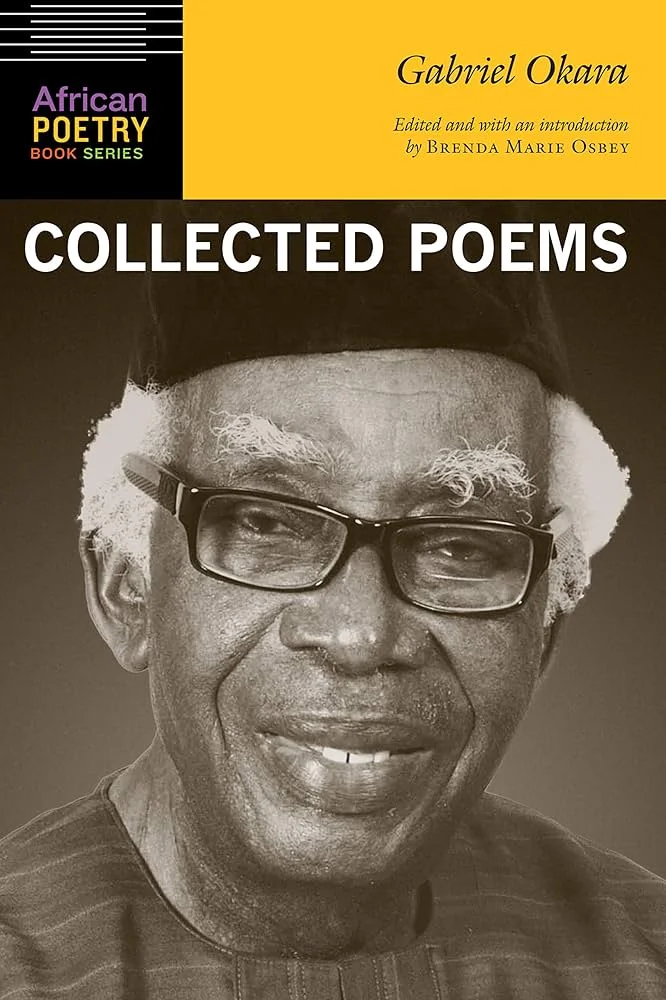
Gabriel Okara, often hailed as the first significant modernist poet of anglophone Africa, occupies a unique place in literary history. Born in 1921 in Bumodi, in Nigeria’s Niger Delta, he came of age during a period when colonial and indigenous cultures coexisted in uneasy tension.
His poetry reflects this duality, bridging English—the language of colonial education and global reach—with the rhythms, imagery, and sensibilities of his native Ijaw and other African languages. Okara’s bilingualism was not merely a matter of speaking two tongues; it profoundly shaped his poetic style, allowing him to create a voice that was both rooted in African tradition and accessible to international readers. His work demonstrates how language itself can become a site of negotiation, creativity, and cultural resistance.
The colonial encounter and linguistic duality
Okara grew up in a Nigeria shaped by colonial education, where English was the official language of administration, schooling, and literature. At the same time, his Ijaw heritage immersed him in oral traditions, proverbs, folktales, and songs in local languages. This linguistic duality exposed him to two very different worldviews: one shaped by European rationalism and linearity, the other by African communal rhythms and metaphorical richness. Rather than choosing one language over the other, Okara fused them, crafting poetry that blended English syntax with the cadences of African speech. His bilingualism became the foundation for a new literary form that resisted colonial erasure while still engaging a global audience.
Translating African thought into English
One of Okara’s most distinctive stylistic features was his ability to translate African concepts into English without losing their cultural resonance. In his famous poem “Piano and Drums,” he contrasts the simplicity and primal power of traditional African life, represented by drums, with the complexity and alienation of modernity, represented by the piano. The diction and imagery reflect African oral traditions, yet the poem is written in English, making the experience legible to international readers. Okara’s bilingualism allowed him to act as a cultural translator, bringing African philosophies and aesthetics into English literature while retaining their local authenticity.
The influence of orality and African rhythms
Okara’s poetry is deeply influenced by the oral traditions of his Ijaw culture. He often incorporated repetition, parallelism, and rhythm reminiscent of oral storytelling. This orality reshaped English into a vehicle for African expression, breaking away from the rigid structures associated with colonial literature. His bilingualism made him sensitive to sound and rhythm, as he constantly moved between the tonal qualities of Ijaw and the stresses of English. This sensitivity gave his poetry a distinctive musicality, where the cadence of African speech patterns infused English lines, creating a hybrid form that celebrated cultural duality.
Bilingualism as cultural resistance
Okara’s choice to infuse English with African rhythms was also an act of cultural resistance. In colonial Nigeria, English often symbolized power and authority, while indigenous languages were marginalized. By reshaping English to express African thought patterns, Okara challenged the hierarchy between colonial and indigenous cultures. His bilingual style asserted that African languages and traditions had equal literary value, even when expressed through English. This resistance was subtle yet profound: it demonstrated that colonized peoples could take the colonizer’s language and make it their own, bending it to serve African identities and narratives rather than suppressing them.
The balance between accessibility and authenticity
Okara’s bilingualism also required him to strike a delicate balance between accessibility to non-African readers and authenticity to African audiences. Too much reliance on indigenous idioms risked alienating those unfamiliar with the cultural context, while too much conformity to standard English risked erasing local meaning. His poetry often walked this tightrope, using metaphor and imagery that resonated across cultures while retaining specifically African textures. In doing so, Okara created a poetic style that spoke simultaneously to local and global audiences, embodying the hybridity of postcolonial literature.
The symbolic role of English and Ijaw
In Okara’s work, English and Ijaw often symbolize two different ways of seeing the world. English carries associations of modernity, colonial power, and rational order, while Ijaw represents tradition, communal values, and spiritual depth. Rather than positioning them in irreconcilable opposition, Okara’s bilingualism allowed him to dramatize their interaction. His poetry reveals the tension of living between two languages and cultures, but it also points to the creative possibilities of this duality. By embodying both traditions, Okara showed that bilingualism could enrich rather than impoverish poetic expression.
The role of imagery shaped by two languages
Okara’s bilingualism is especially visible in his imagery. His metaphors often draw from the natural environment of the Niger Delta—rivers, forests, animals—but he frames them within English poetic conventions. This fusion creates striking images that feel at once local and universal. For instance, his use of water as a symbol of continuity and renewal resonates with African cosmologies while also appealing to broader human experiences. His imagery demonstrates how thinking in two languages can expand the range of poetic expression, blending distinct traditions into a new aesthetic language.
Influence on African modernist poetry
Okara’s bilingual style positioned him as a pioneer of African modernism. While writers like Wole Soyinka and Chinua Achebe also grappled with questions of language, Okara’s poetry foregrounded the creative tensions of bilingualism more directly. His work showed that African literature did not have to choose between English and indigenous languages but could invent hybrid forms that spoke to both. This influence helped shape a generation of poets who sought to reclaim English for African expression while honoring their oral and cultural traditions. His bilingualism thus not only shaped his own poetic style but also contributed to the evolution of African literature as a whole.
Personal identity expressed through language
Okara’s bilingualism also reflected his personal identity. Living between cultures, he used poetry to negotiate questions of belonging and heritage. His poems often reveal a sense of ambivalence—nostalgia for traditional life, anxiety about modernity, and a longing for integration. Language became the medium through which he explored these tensions, with English and Ijaw offering different lenses on the same reality. His bilingual style was, therefore, not just a literary technique but also an expression of his lived experience in a postcolonial world.
A voice forged in two languages
Gabriel Okara’s bilingualism shaped his poetic style by infusing English with the rhythms, imagery, and sensibilities of African oral traditions. His ability to move between languages enabled him to act as a cultural translator, a literary innovator, and a voice of resistance against colonial dominance. At once accessible to global readers and authentic to African traditions, his poetry reflects the complexities of identity in a multilingual, postcolonial context. In Okara’s hands, bilingualism was not a burden but a source of creative power, allowing him to forge a poetic voice that was truly his own—rooted in two traditions yet transcending both to speak to the human condition.