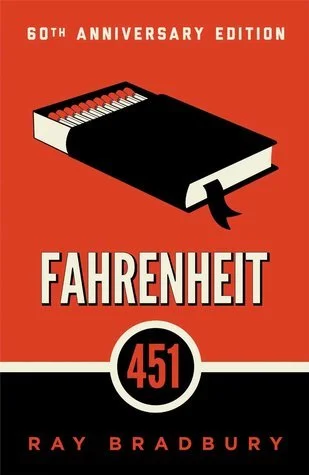
Ray Bradbury’s Fahrenheit 451, published in 1953, remains one of the most powerful dystopian novels of the 20th century. Set in a society where books are banned and “firemen” burn them, the novel uses fire as both a destructive and regenerative symbol.
Fire dominates the imagery, shaping the narrative’s mood and the reader’s understanding of censorship, control, and transformation. While initially fire represents suppression and conformity, Bradbury gradually expands its meaning to include warmth, knowledge, and renewal. This duality makes fire the central symbol through which the novel explores both oppression and hope.
Fire as a tool of censorship and control
At the beginning of the novel, fire is primarily associated with destruction. Firemen no longer put out fires but instead ignite them, burning books and the houses that conceal them. For the government, fire is the most effective tool of censorship—it erases not only physical objects but also ideas. This destructive quality of fire symbolizes the authoritarian state’s attempt to eliminate dissent and independent thought. Montag, the protagonist, initially delights in the spectacle of flames, seeing them as symbols of power. The government’s use of fire demonstrates how something naturally chaotic can be harnessed as an instrument of social conformity.
The false warmth of fire in Montag’s society
In the dystopia of Fahrenheit 451, fire also represents false comfort. Citizens are surrounded by superficial entertainment, designed to distract them from critical thinking. In the same way, the fires set by firemen serve as public spectacles, thrilling displays that reinforce obedience. The community’s awe at burning homes reflects how the state manipulates fire to create an illusion of unity and excitement. Instead of being a genuine source of warmth, these fires leave only ashes, symbolizing the emptiness beneath the regime’s promises of happiness.
Fire as a mirror of Montag’s transformation
As the novel progresses, fire evolves alongside Montag’s inner journey. At first, he is enthralled by its destructive beauty. But when he meets Clarisse, a young woman who challenges his assumptions, and later witnesses a woman choosing to die with her books rather than live without them, his perception of fire begins to shift. The flames that once represented control now embody the horror of oppression. This change in perspective illustrates Bradbury’s use of fire as a mirror of Montag’s awakening consciousness. Fire no longer appears glorious—it becomes a reminder of the cost of censorship and ignorance.
The fire at the old woman’s house
One of the pivotal scenes in the novel occurs when the firemen are called to burn an elderly woman’s home. Unlike other victims, she refuses to abandon her books, choosing instead to perish with them in the flames. This moment crystallizes the symbolic weight of fire: it reveals both its destructive capacity and its power to inspire resistance. The woman’s choice shocks Montag, forcing him to recognize that the ideas contained in books are powerful enough to make someone embrace death rather than surrender knowledge. Here, fire becomes paradoxical—it destroys, but it also ignites curiosity and rebellion in Montag.
Fire as knowledge and enlightenment
Midway through the novel, Bradbury introduces a new dimension of fire’s symbolism. When Montag encounters Faber, a retired English professor, he learns that fire does not always destroy. Books themselves can be seen as sparks of knowledge, capable of igniting thought. This metaphorical fire contrasts with the literal flames of censorship. Faber helps Montag see that true fire—intellectual fire—illuminates rather than eradicates. Bradbury thus transforms fire into a symbol of enlightenment, representing the inner combustion of ideas and the light they bring to human existence.
The chase and the televised spectacle
When Montag kills Captain Beatty and flees, the fire becomes an inescapable presence in his life. The city watches his escape on massive television screens, turning the pursuit into another form of public spectacle. The government’s use of fire and media demonstrates how destruction and distraction intertwine in authoritarian regimes. Fire here is both literal—Montag is hunted for using it against authority—and symbolic, as his rebellion ignites curiosity and defiance in the audience. This moment highlights how fire, once a tool of suppression, can unexpectedly spark subversion.
The campfire in the wilderness
Montag’s journey takes a dramatic turn when he escapes the city and discovers a group of exiles who have preserved books by memorizing them. For the first time, he sees fire not as destruction but as a source of warmth and community. The small campfire in the wilderness symbolizes renewal and human connection. Unlike the roaring infernos of censorship, this fire provides light, warmth, and comfort. It embodies a nurturing energy, suggesting that fire can sustain life rather than obliterate it. This reversal completes Montag’s transformation and redefines fire as a positive, constructive force.
Fire as a cycle of destruction and renewal
The novel concludes with the destruction of the city by bombs, an ultimate firestorm that annihilates the oppressive society. While devastating, this destruction is followed by the hope of rebuilding. Montag and the exiles envision a future where knowledge, preserved through oral tradition, can guide humanity toward renewal. Fire here takes on its most complex meaning: it is both the end and the beginning, a force that clears away the old so that something new may grow. This cyclical symbolism echoes ancient myths where fire is both destructive and purifying, essential to transformation.
Layers of symbolism in Bradbury’s fire
Bradbury’s multifaceted use of fire in Fahrenheit 451 illustrates its dual role as both a weapon of oppression and a catalyst for change. It symbolizes censorship, false happiness, and authoritarian power, but also knowledge, warmth, and renewal. The shifting symbolism parallels Montag’s evolution from conformity to resistance, showing how perspective can alter meaning. By the end of the novel, fire emerges not merely as an image of destruction but as a metaphor for the enduring cycle of human resilience. Bradbury’s choice to center his dystopia around fire underscores its timeless role as one of humanity’s most potent and ambivalent symbols.
The enduring spark of Bradbury’s vision
Fire in Fahrenheit 451 is more than a narrative device—it is the lens through which readers confront the fragility of culture and the resilience of human spirit. Its many meanings remind us that destruction and creation are intertwined, and that renewal often requires risk. By portraying fire as both a tool of tyranny and a source of rebirth, Bradbury crafted a symbol that continues to resonate with modern audiences. The enduring spark of his vision lies in this paradox: even in the darkest flames of censorship, there remains the possibility of light, warmth, and renewal.